



Major Depressive Disorder(MDD)Model
Topgenebio has successfully established a rhesus monkey model of MDD. This model shows typical depressive-like behaviors, including huddling-like behavior and stereotyped behavior, accompanied by elevated plasma levels of inflammatory cytokines. Characterized by a high success rate and the ability to achieve batch modeling, this MDD monkey model provides strong CRO services for pharmacodynamic and safety evaluations to drug R&D institutions focusing on MDD.
NHP Models of Major Depressive Disorder(MDD)

- After classifying and quantifying the behaviors of the test monkeys, it was found that at weeks 4 and 8 of stress, the duration of huddling-like behavior (Fig. 1.A) and the duration of stereotyped behavior (Fig. 1.B) significantly increased.
- Plasma levels of various inflammatory cytokines in the experimental monkeys were measured using the MSD method. The results showed that at week 10, the plasma concentrations of IL-6 (Fig. 2.A) and TNF-α (Fig. 2.B) were significantly higher compared to pre-stress levels.
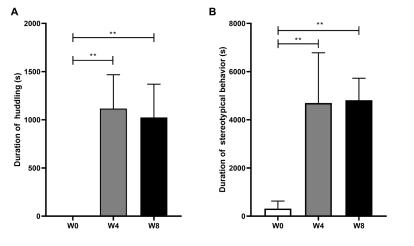
Figure 1 Statistics of depressive-like behaviors in experimental monkeys . (A) Duration of huddling-like behavior in experimental monkeys at weeks 4 and 8 of stress; (B) Duration of stereotyped behavior in experimental monkeys at weeks 4 and 8 of stress.
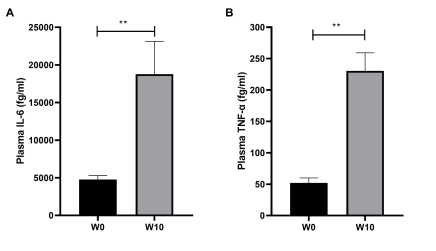
Figure 2 Plasma concentrations of inflammatory cytokines in experimental monkeys. (A) Plasma concentration of IL-6 in experimental monkeys at week 10 of stress; (B) Plasma concentration of TNF-α in experimental monkeys at week 10 of stress.
-

-
 Topgene Biotechnology
 -
 marketing@topgenebio.com
 -

